
Ain't Dere No More
When Hurricanes Wipe Out Hotels, and What Could Land in Their Place


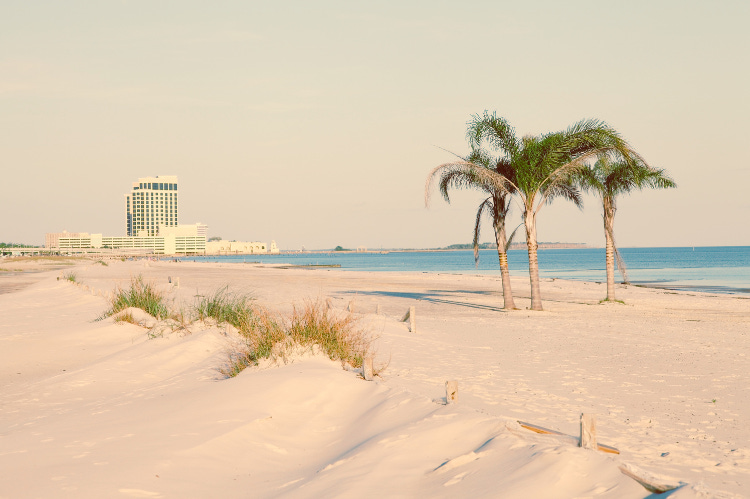
A few months after Hurricane Katrina made landfall in late August 2005, my partner Justin and I took a road trip to North Carolina. On the way back, we drove south through Mississippi and landed in what had once been familiar and comfortable territory: the waterfront region of Gulfport-Biloxi.
Except while the map said that’s where we should be, nothing looked like the place we remembered.
In February 2005, we spent a weekend in the same area. We were inspired by Justin’s mom, who the year before, had driven alongside the Gulf Coast from Florida to Louisiana, arriving in New Orleans marveling at the charm and affordability of waterfront property in small Mississippi towns like Ocean Springs and Pass Cristian. We took off on a Friday afternoon to enjoy a leisurely, poorly-planned getaway (our favorite kind!).
Our first night, we stayed in one of the dirtiest hotel rooms I’ve ever seen. The carpet, bedding, and curtains were dusty and full of mold. The bathroom literally had poop smeared all over it.
Our first night, we stayed in one of the dirtiest hotel rooms I’ve ever seen. The carpet, bedding, and curtains were dusty and full of mold. The bathroom literally had poop smeared all over it. We had tried to stay at a nice mid-range hotel next door, but the rooms were all booked up; they directed us to what I’ll call the Poop Bathroom Inn. It was obviously a mom and pop joint, but it had its charm. And by charm I mean they had a room available on a Friday night on a beautiful, mild February weekend. Also, it was directly across the street from the beach.
The second night, we found a more comfortable spot—probably at a casino. But I don’t remember anything about that other hotel. I do remember, though, peeling the dirty comforter back in our room at the Poop Bathroom Inn, sitting on the bed with Justin as the sun started to set outside, drinking juice and smoking cigarettes (because it was 2005 in Mississippi, and there were definitely no rules about smoking at this hotel).
Our conversation that evening focused on the business Justin was about to open. We went over all kinds of things, from the renovation timeline to the type of bar he wanted it to feel like, to the name. I recall us going through some options that were on the table and we kept coming back to one that was a little odd, but somehow felt right: Handsome Willy’s.
It was one of those chats that one remembers 20-something years later, through decades of ups and downs and successes and failures. It felt so intimate and important—because it was. Our lives are still shaped by what we talked about that day, and I think of that time often as we continue to make decisions together now, especially about those big life tracks that we have to lay out sometimes, even when we don’t want such a firm grip on the future.
On that February weekend in 2005, the coastal highway felt like an unbroken string of connected beach towns: a little touristy, with a familiar mix of Gulf Coast chain surf shops and mom and pop stores, a Waffle House with a view of the water, and the various casinos that were built on floating barges just at the edge of land, to adhere to Mississippi’s gambling laws at the time. In my memory, there were very few vacant lots or wide open spaces, and everything felt cozy and cohesive. The 20-mile stretch from Gulfport to Bay Saint Louis, where my aunt and uncle lived, was alive and flourishing.
After Katrina devastated the city, “Aint’ Dere No More” became a commonly-used phrase among residents, especially as memory worked in funny ways.
Less than a year later, when we exited the highway in what I think was Gulfport, we were speechless. For miles, as we drove west toward New Orleans, all we saw was land that looked scraped clean, for as far back from the shore as we could see. Occasionally we’d try to orient ourselves by connecting to the past: Was that maybe where the Waffle House was, on the empty concrete slab surrounded by grassy sand? Was this the place where we had searched for a decent hotel, only to end up at the Poop Bathroom Inn? We never were sure. Eventually, we had to exit the coastal road and return to the I-10, as the bridge over Bay St. Louis had been destroyed by Katrina. It would be another 18 months before it reopened.
As time went on, and we occasionally returned to the coast for a visit, we saw small, piecemeal signs of development. For several years after the storm, the casinos were the anchor for—and in many places, the only visible marker of—a changing landscape. In fact, since 2005 I’ve only stayed at a casino hotel when visiting the Mississippi coast, because that’s pretty much all that’s on offer.
In New Orleans there’s a phrase, made popular by local comedian/musician Benny Grunch who wrote a song by the same name: “Ain’t Dere No More.” What started as a joke about nostalgia became its own form of collective nostalgia, and for better or worse, the phrase is now a part of the region’s identity. While I can’t find the original release date, the song alludes to changes that happened before Katrina, highlighting economic and cultural shifts that reshaped the city, such as turn-of-the-century high-rise hotel development along Canal Street, and the rise of t-shirt and souvenir shops that became a staple of French Quarter tourism.
After Katrina devastated the city, “Aint’ Dere No More” became a commonly-used phrase among residents, especially as memory worked in funny ways. Wait, I’d tell myself, isn’t there a Popeye’s on that corner? I’d remember going through the drive-through like it was just a few months ago, and then someone—my mom, my sister, or Justin, maybe—would remind me: that Popeye’s store has been gone for three years, the building torn down, an empty lot in its place. Eventually a large corporation would build an urgent care facility there.
But like that night in the Poop Bathroom Inn, we have to move forward in terrible conditions, even if we’re not quite ready. We have to make decisions, however imperfect the context.
In her 2007 book, The Shock Doctrine, Naomi Klein talks about disaster capitalism, citing economic policies after Katrina alongside dozens of examples where devastation is the driving force behind “development.” We definitely saw these changes following the storm in New Orleans, and Klein highlights them elsewhere, in the numerous cases where those with money profit from someone else’s loss, and at times, manufacture losses for their own gains. (In grade school, as we spent eight weeks covering the U.S. Civil War, we learned a related term—carpetbaggers—which I discovered later, in California, was not something one should say jokingly at a party.)
Nowadays, there are very few, if any, mom and pop motels along the Mississippi Gulf Coast. Despite the incredible vulnerability of the region, and a clear history of devastating storms, land is prohibitively expensive. There are more vacation rentals than ever before, a reflection of a larger investment trend that was slow to take hold in this rural southern locale despite the water and natural beauty. Now, large-scale lifestyle developments are on their way, marketed to New Orleans-area residents looking for an accessible weekend home or a permanent move from the city.
Scientists, scholars, and politicians have been telling us for years that disasters are on the rise, our environment is getting worse, etc. COVID showed the extent to which our entire world can shift due to a sudden, widespread catastrophe. The modern world, with its perpetual war and other political chaos, feels overwhelming, and abstract entities control most of our daily cultural experiences, especially in the U.S.
But like that night in the Poop Bathroom Inn, we have to move forward in terrible conditions, even if we’re not quite ready. We have to make decisions, however imperfect the context. How we choose to move through the world will help us cope with the mess of it, even if we feel powerless in the face of power. For many, nostalgia is their anchor of comfort in a changing world, something we’ve seen conservative politicians grab onto in trying to win over audiences hoping to make sense of social and economic chaos. For Benny Grunch, the particular sentiment he expresses is one familiar to many older, white New Orleanians, especially ones who left the city to inhabit segregated suburban enclaves in the 60s and 70s: What happened to the New Orleans that I knew, the one that was built for me and me alone, on a foundation of gross historical inequities?
Celebrating the past for the sake of it isn’t going to cut it, but remembering its materiality will. Maybe that’s why, despite its origins coming from a particular white, conservative sentimentalism, “Ain’t There No More” remains popular: it grounds us to specific places and experiences of the past, in a geographical sense. This kind of physical, immediate connection is empowering, especially as abstract entities take over everything and disconnect us from our experiences. Disasters of all kinds—environmental, economic, social, political—are going to take away what’s familiar. We just can’t lose ourselves in the chaos. That afternoon, as Justin and I drove through what felt like the Twilight Zone of post-Katrina Mississippi, it helped to remember the bigger picture of where we were, and where we were going. I hope that now, we can continue to do the same.
Loved this!
Great piece, thank you!