
Why do we love beige boxes?
(Wait, DO we love beige boxes?)

Hello and welcome to the first issue of Hotel Happiness!
You won’t usually hear from us twice in one week, but we wanted to get our Thursday publishing schedule going.
Like a lot of you, our hearts and minds are in Minneapolis (a city Sara was honored to call home for three years, and where people she loves still live) and with everyone under attack across the country. We’re working on a piece on how Hilton entered the discourse and what the controversy tells us about hospitality.
Today though, we want to offer a little more context for this project. One of our hopes is that it will spark your memories, stories, theories, etc. If so, we would love to read about it in the comments. This week’s piece by Sara Tatyana Bernstein is written as much as a prompt for you as it is her own reflections.
Until next Thursday!
— Sara and Elise
This is not (not) a third place
Amy and I are sitting in a horseshoe booth in the bar of a loud seafood restaurant. Our first choice was the bar at a historic downtown hotel next to the concert hall. Alas, that spot was full. Soon, we’ll enjoy a night of leading lady’s showtunes, sung by a charming man in a cardigan, accompanied by four women on piano and strings. But first we’ll share a favorite restaurant meal: salad and french fries with glasses of pinot gris. Amy is one of my oldest friends, and in this moment I am…happy.
Happiness has been hard to come by lately. I got DOGE’d from my dream job in the spring, right after my partner was laid off. Our beloved cat just died after a year-long illness. I’m recovering from an extended ear infection. An authoritarian regime is sledgehammering our democracy. Neighbors are being disappeared by masked police. Our city is, once again, shorthand for “radical left lunatics” in need of violent control. But at this moment, eating french fries and sipping wine, talking about books and sweaters with my friend, I am happy.
After the food arrives, I speak over the business drunk hum behind us, “Elise and I are thinking about doing a new…thing—a newsletter, maybe?--about hotels. But not fancy ones or interesting ones. Just, like, mid-range corporate chains. It would be kind of a mix of personal essays, ethnography, interviews, that kind of thing.”
“How did you land on that topic?” Amy asks while I pass her the salad.
“Well…” The recovering academic comes out first, as if I have to defend my thesis. “They’re really interesting as a site where a lot of different people come together. Like an in between place. A nothing that’s also a hub. An experience everyone can relate to…But mostly, we just like them. It’s something we’ve always bonded over. Like our…you know—the thing you’re not supposed to like but you do?” Between the wine and the last few months of stress and limited socializing, I’m both rambling and grasping for words.
“Guilty pleasure?” Amy offers.
“I suppose that’s it.”
“Well, I would totally subscribe to that.”
“Yeah?” I lean forward. “Do you like them, too?”
“I hate them,” Amy says emphatically and I laugh. Pressed for details, she rattles off an unassailable list of flaws. “I can never sleep. You can’t open the windows, so the air is always stuffy.”
I agree and add some of my own complaints—the complimentary breakfast is usually pointless. In fact, I rarely use any of the amenities I’m paying for. The bedding is polyester but the pillows are often down, so it’s allergies up top and sweat below.
“So why do you like them?” Amy asks.
I pause, trying to compose the sentence that will encompass a jumble of childhood nostalgia, theoretical fascination, the pleasure of being in a place where I’m not responsible for anything, maybe some irony, some Gen Xish delight in a new kind of kitschy corporate Americana, but also just…real affection. And all I can say is, “I don’t know. I guess that’s what the newsletter is for.”
On paper, this endearment does not make sense. In most realms of life I am annoyingly critical of multinational corporate brands. I support local businesses as much as possible. I live in a hundred-year-old 4-plex in a historic neighborhood. I cannot imagine any landscape more depressing than the commercial areas on the outer fringes of American cities where many of these hotels are located. The relentless homogeneity of strip malls, fast food, gas stations, big box stores. The stuff, the hyper-consumption, the waste, the alienation. It all bums me out and I usually avoid it.
But people are complicated.
At various times I’ve also written about my complicated love for Payless Shoes, shopping malls and Denny’s (my very first publication, written when I was 20. I’ll share it down the road if I work up the courage). Those were all flawed spaces that produced waste, exploitation, and sometimes subpar products. They reinforced a cultural conception of self based on acquisition. The latter two were also accessible “third places,” that gave me room to build community and explore who I wanted to be even when my funds were extremely limited and I was living far away from the urban centers where “good taste” was supposedly made. Now, these spaces are gone or in steep decline. They are relics of a different era of consumer culture.
Mid-range hotels are not the same as mid-range family restaurant chains or malls. Hotels are not places where teenagers hang out after school, or co-workers meet to vent about the boss over a drink while families from different social strata sit side by side eating the same breadsticks on a Tuesday night. Or…they are those things but they’re also removed from them. They encapsulate the mundanity of daily life while simultaneously offering an escape from it. They are not a third place. They are home, work, and neither all smushed together.
In fact, few places have emerged to fill the third place and Americans are more anxious, depressed, and lonely than we have ever been. But, when you happen to find yourself there, these hotels do provide some third-place-adjacent benefits.
My partner and I recently spent a weekend at the Hampton Inn in West Eugene. We stay there whenever a family gathering at my mom’s grows larger than her two bedroom country home can hold, even though her neighbors would happily let us sleep in their ADU for free. We are introverts and even (especially?) with family, it’s nice to have a neutral retreat. This was a happy and sad trip to spend time with my sisters and cousin, as well as bury our best cat friend in the orchard behind my mom’s house. During the day we cooked food, did puzzles, laughed a lot, told stories, went to a museum, walked through an old cemetery in crisp fall sun. At night, Tim and I let our brains soften into porridge, watching HGTV and snippets of My Cousin Vinny in a clean, spacious, mostly quiet, somewhat stuffy void of a room.
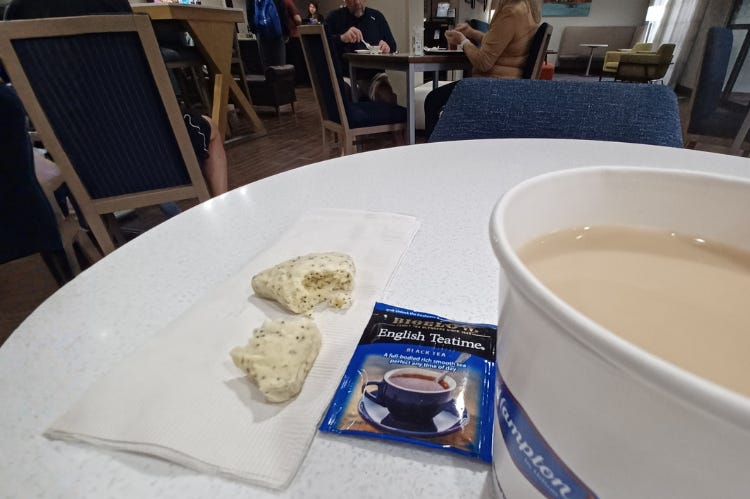
And one morning, while I made tea at the breakfast bar (those pods in the room taste like plastic and stale coffee), I eavesdropped on two middle-aged couples—one from Southern California, the other from Minneapolis, both in Oregon for the first time—swap stories about what brought them to the Hampton Inn in West Eugene in early November.
This is all me still trying to answer Amy’s question. Why do I like these hotels so much? I think in some ways, it’s similar to the happiness I felt when she asked it.
On that night out with Amy, in the bar of a nice-ish seafood restaurant, sharing french fries before a concert—a totally normal thing that we rarely do—during an especially dark season, the place, the food, the wine, even the music weren’t what made me happy. They were setting and props for the star of the show: our conversation.
Likewise, it’s possible it isn’t the hotels themselves that I enjoy. They are instead a neutral backdrop for moments that take me out of myself and my routine, they are a blank page to write stories on. A beige sandbox for playing with ideas. Mid-range hotels are an empty stage that we can use to build connections and start conversations. Anyway, that’s one theory.
And it is our hope for this newsletter—we want this to be a place for conversations. So now we would love to hear from you. What do you love? What do you hate? How do you really feel about the Best Westerns and La Quinta’s and Red Roof Inn’s in your life?
This really resonated, Sara. I love the idea of beige hotels as neutral backdrops for connection, not the point but the container. Sometimes happiness shows up quietly in those in between spaces.
Guilty pleasure: the waffle iron at the continental breakfast counter (it’s not a buffet!). Flip it, wait for the beep, walk away.